
Research
Research Overview
My research integrates polymer physics, dielectric physics, and polymer nanocomposite science blended with an engineering approach to advance energy materials for next-generation electronics and storage technologies. Using various techniques like broadband dielectric spectroscopy, as well as, dynamic mechanical analysis, rheology, and calorimetry, and combined with rigorous data analysis and fitting approaches, I establish relationships between molecular characteristics, relaxation and charge transport dynamics, and performance. This enables rational design of materials with tailored electrical, thermal and mechanical properties. By optimizing processing and structure–property relationships, my work advances scientific understanding and technological innovation to address global energy challenges.
Representitives Research Articles
Segmental dynamics and local motions in disordered random copolymers
Macromolecules (2026)
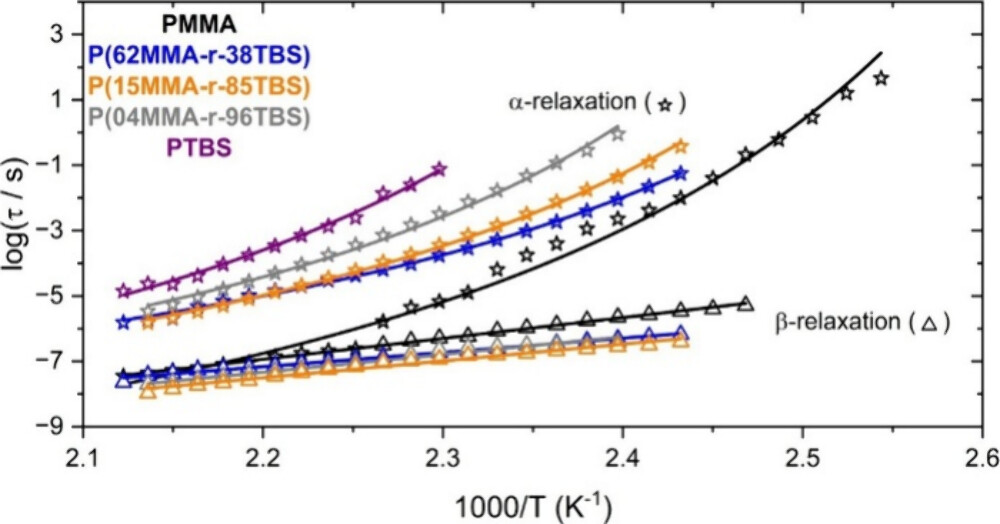
Understanding the glass transition in amorphous polymers and the underlying principles that govern segmental motions remains a key challenge in polymer physics. Here, we investigated random copolymers composed of methyl methacrylate (MMA) and 4-tert-butylstyrene (TBS) monomers across various compositions to elucidate the influence of monomer bulkiness on the glass transition temperature (Tg), fragility (m), and segmental dynamics. The calorimetric Tg values were observed to strongly deviate from the Fox equation, showcasing a structure-independent behavior at high to medium MMA concentrations, and a ‘super-Fox’ increase at low MMA content. We correlated this to tacticity as well as frustrated chain packing, as corroborated by changes in the m values. A closer look at the β-relaxation revealed a strong dependence on the molecular composition: below the Tg, the activation energy decreased with TBS, indicating a transition toward a side-group reorientation-dominated mechanism, while above the Tg, the TBS monomers participate in the process, despite PTBS lacking a β-relaxation. The coexistence of TBS and MMA monomers revealed a fundamental shift in relaxation dynamics manifested by the decoupling of α- and β- relaxations, which we analyzed via the double-percolation mechanism. Our findings offer new insights into polymer relaxation behavior and the relationship between the α- and β- relaxation mechanisms with implications in materials optimization. Read more
Polyacrylate Vitrimer Network via In Situ Isocyanide Copolymerization: Synthesis and Molecular Dynamics
Journal of the American Chemical Society (2026)
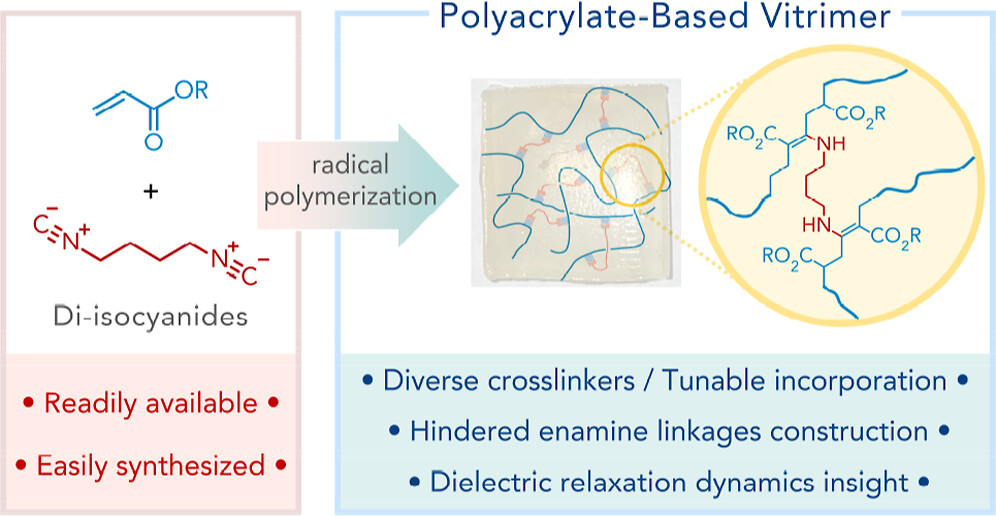
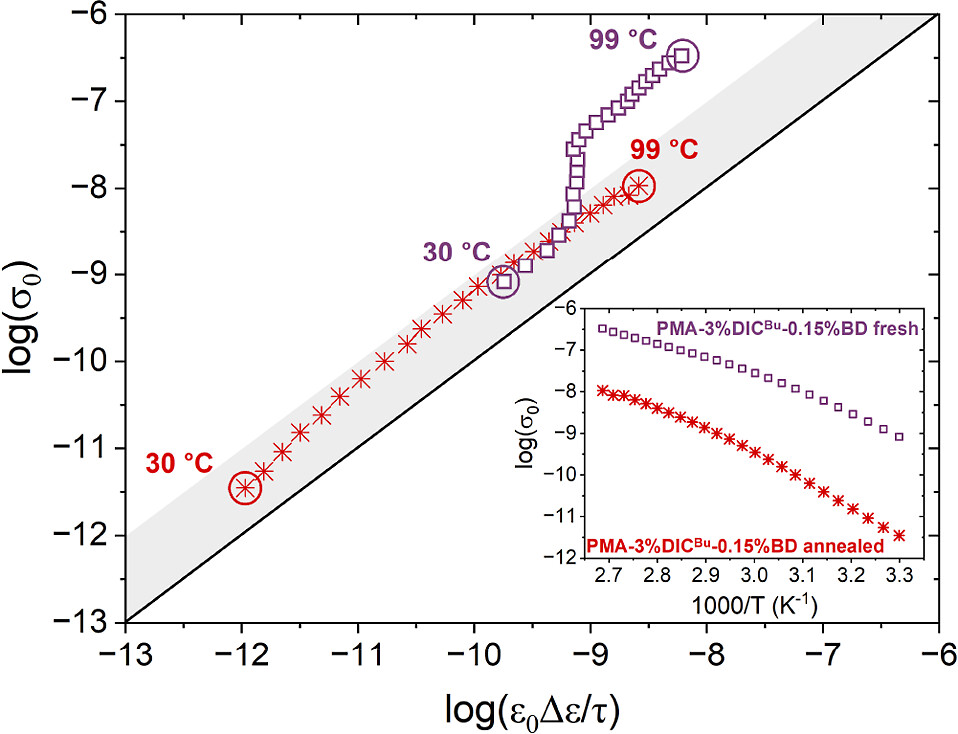
Widespread plastic pollution highlights the urgent need for materials with sustainable end-of-life management. Vitrimers, cross-linked polymers containing dynamic covalent bonds, combine the durability of thermosets with their recyclability. Here, we report a one-step photocopolymerization using multifunctional isocyanides as readily accessible cross-linkers that directly introduce vinylogous urethane-like linkages into polyacrylate networks, structures difficult to obtain via amine–β-ketoester condensation. The resulting materials show good reprocessability, maintaining a comparable mechanical performance after three processing cycles. Broadband dielectric spectroscopy (BDS) reveals that the temperature dependence of the bond-exchange relaxation times evolves from a kink-like response in fresh samples to Arrhenius behavior after annealing, visualizing topological rearrangement and defect healing. A scaling relationship between bond-exchange relaxation and electrical conductivity establishes that the former is the underlying mechanism for charge transport in vitrimers. Furthermore, dipolar intermediates generated during bond exchange increase the dielectric permittivity, providing new insight into designing sustainable dielectric materials. Read more
Universal Scaling of DC Conductivity with Dielectric Interfacial Polarization in Conjugated Polymers
Macromolecules (2024)
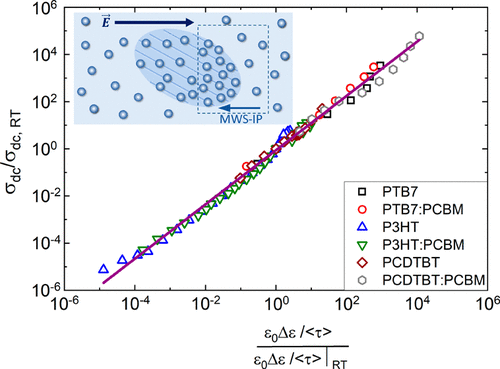
Understanding the intricate relationship between conductivity and polymer film microstructure is paramount to designing and developing high-performance conjugated-polymer-based electronic devices. Conjugated polymers are typically semicrystalline, and their films comprise both highly crystalline and amorphous regions with significant disparity between the conductivity of these regions. However, traditional conductivity measurements under steady-state conditions overlook the presence of the amorphous phase, offering an incomplete perspective on charge transport. Here, by employing isothermal dielectric measurements, we reveal that the amorphous phase plays a pivotal role and dominates the electrical conductivity at temperatures more pertinent to practical applications, while the crystalline fraction takes precedence at temperatures below room temperature. The conductivity mismatch between the amorphous and crystalline phases yields the Maxwell-Wagner-Sillars interfacial polarization (MWS-IP) effect. Here we demonstrated that the existence of MWS-IP ensues a universal scaling between the electrical conductivity, the relaxation time and the dielectric relaxation strength, for various conjugated polymers and their blends. Shedding light on the contribution of the amorphous phase in the conductivity of conjugated polymers can lead to the development of new polymers for applications in electronic devices with improved performance at operationally relevant temperatures. Read more
Epoxy/clay nanodielectrics: from relaxation dynamics to capacitive energy storage
Advanced Composites & Hybrid Materials (2024)
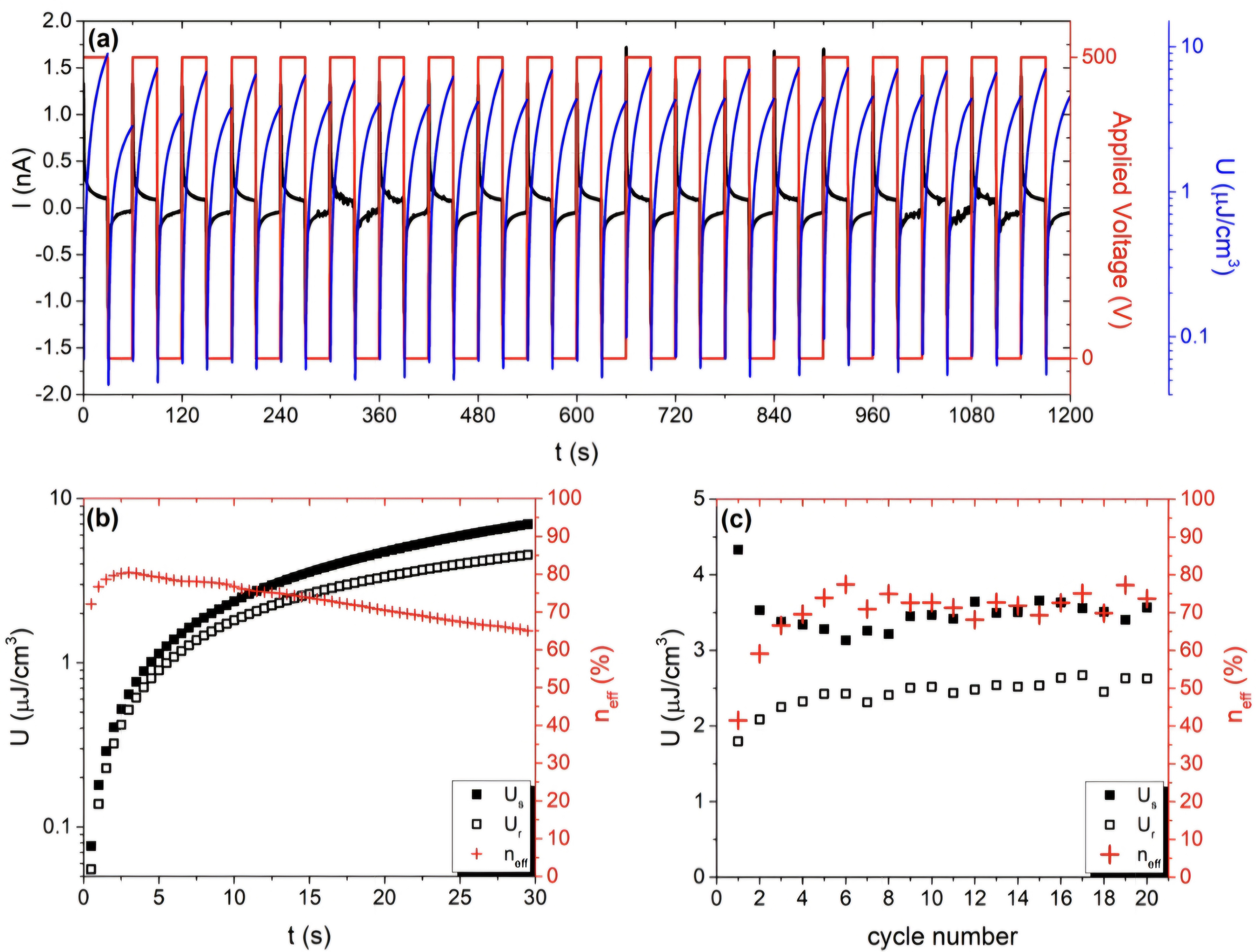
Nanodielectric systems based on a high glass-to-rubber transition temperature (Tg) epoxy resin modified with laponite® (Na+0.7[(Si8Mg5.5Li0.3)O20(OH)4]–0.7) cylindrical nanoparticles were developed and examined as dielectric materials for capacitive energy storage applications. Laponite is an inexpensive synthetic nanoclay that has recently gathered attention as potent electrode material for batteries, due to its high specific surface area and ionic groups. The dielectric properties of the developed nanocomposites were investigated extensively by means of broadband dielectric spectroscopy (BDS), which revealed intense Maxwell–Wagner-Sillars interfacial polarisation (MWS-IP) phenomena at the organic/inorganic interface and an additional dielectric process that showed a strong dependence on the nanoclay concentration, thus attributed to laponite (IDE). It was also found that the presence of laponite significantly altered the temperature dependence of MWS-IP, leading to an enhancement in relaxation times at higher temperatures. The observed phenomenon is attributed to less mobile, adsorbed polymer fragments entrapped between two or more laponite nanoparticles that alters the interphase between the particle and the epoxy. MWS-IP was observed to obey the Barton-Nakajima-Namikawa relation with the dc conductivity values being indicative that both phenomena are associated with the same charge carriers, at different timescales. Moreover, the cycle life performance of epoxy/laponite nanodielectrics was also examined at 30 °C and 120 °C conducting charge/discharge measurements in dc conditions. The addition of laponite nanoparticles endowed the nanodielectric systems with significantly improved capacitive energy efficacy. Read more